Lesson / November 20, 2026, updated November 21
One mech brief, three builders
Someone posted a public thread about a scripted walking mech built in Blender. The Studio ran the same job overnight with Opus, then Sonnet, then two local models. We kept the numbers we had. Here is how it went, with the scripts.
Update, November 21, 2026
The first version of this page admitted that Mossback looks light. So we wrote a weight check, ran it on every build, and gave both Claude mechs more rounds of fixes, with a new reviewer each round. We also handed the brief to Claude Haiku as a fourth builder.
What we learned. In the first round both mechs went from failing our weight check to passing it, and reviewer scores for weight moved by a point or so. A 10 cm drop on a 5.7 m machine is under 3 pixels on a 390 px wide phone, too small for reviewers to pick out. What they did pick out was the whole body moving, the mech rolling its weight over the planted leg, and drops of 25 cm or more, like the dead stop in Haiku's build. They also kept pointing at the shape. Thin legs read as light in every round, whatever the body did. After three rounds the last reviewer gave Mossback's weight a 6 out of 10 where v3 got a 4. Most of the gain came from the deep knee give and the dust.
The weight check
It is a Blender script, weight_check.py, and it reads any walk that has a hull and feet. A cab is optional. On every frame it finds each footfall (a foot coming down to within 1 cm of the ground after lifting at least 5 cm), then follows the hull and the cab until the next one.
- Hull drop: how far the hull falls after the foot lands, and how many frames it takes to bottom out.
- Cab settle: how far the cab sinks on its own mounts, measured in the hull's frame, so the walk's bob does not count.
- Overshoot and settle time: how far the cab rebounds past where it comes to rest, and how long until it stays within a quarter of the drop.
- Reported but not gated: knee give (how much the hip to planted foot distance shrinks after a footfall), side sway, foot lift, and, given a camera, how soon its shake peaks after each footfall.
- Phone pixels: each distance turned into pixels on a 390 px wide phone, with the machine filling 70% of the height of a 16:9 frame. At that size Mossback is 154 px tall, and 1 px is 3.7 cm.
We set the gates before tuning anything, from the November 20 reviews. The hull has to drop at least 1.5 px and bottom out within 6 frames. The cab has to sink at least 1.5 px, overshoot by 10 to 60%, and settle within 0.6 s. Mossback v3, the version on the first page, failed only the cab gate. Its cab moved 1.8 cm on its mounts, half a pixel.
| Build | Height | Hull drop | Cab settle | Overshoot, settle time | Knee give | Side sway | Foot lift | Gates | Weight, reviewer |
|---|---|---|---|---|---|---|---|---|---|
| Mossback v3 (Nov 20) | 5.68 m | 9.9 cm, 2.7 px, 3 frames | 1.8 cm, 0.5 px | 32%, 0.42 s | 15 cm | 37 cm | 28 cm | 4 of 5 | 3 to 4 of 10 |
| Mossback v4 | 5.67 m | 9.8 cm, 2.6 px, 3 frames | 10.1 cm, 2.7 px | 42%, 0.50 s | 14 cm | 37 cm | 28 cm | 5 of 5 | 5 of 10 |
| Mossback v5 | 5.68 m | 10.3 cm, 2.8 px, 3 frames | 12.9 cm, 3.5 px | 42%, 0.50 s | 17 cm | 64 cm | 16 cm | 5 of 5 | 5.5 of 10 |
| Mossback v6 | 5.68 m | 27.3 cm, 7.4 px, 4 frames | 10.9 cm, 3.0 px | 37%, 0.58 s | 33 cm | 56 cm | 16 cm | 5 of 5 | 6 of 10 |
| Slagjaw v1 (Nov 20) | 10.04 m | 7.9 cm, 1.2 px, 4 frames | 6.0 cm, 0.9 px | 44%, 0.92 s | 15 cm | 17 cm | 27 cm | 2 of 5 | 3 and 4 of 10 |
| Slagjaw v2 | 8.96 m | 12.3 cm, 2.1 px, 5 frames | 15.3 cm, 2.6 px | 25%, 0.42 s | 18 cm | 17 cm | 27 cm | 5 of 5 | 4 and 5 of 10 |
| Slagjaw v3 | 9.00 m | 17.4 cm, 3.0 px, 5 frames | 21.3 cm, 3.6 px | 26%, 0.42 s | 26 cm | 65 cm | 16 cm | 5 of 5 | 5 of 10 |
| Scrapjaw (Haiku) | 6.30 m | 25.0 cm, 6.1 px, 2 frames | 0.0 cm, bolted on | none, never settles | 24 cm | 0 cm | 35 cm | 3 of 5 | 5 of 10 |
Height is measured at frame 0 to the top of the highest part, antennas included, so Slagjaw's dropped when its cab was sunk into the hull. Side sway is the hull's travel across the direction of the walk, peak to peak. Each round used a new reviewer who saw only phone-size frames, so scores from different rounds don't line up exactly. A row with two scores had two reviewers.
Mossback, three rounds
Round 1 (v4) swapped the old fixed dip for a fall and a catch. Between steps the hull rises over the stance leg, drops the last 12 cm onto the next foot at 1.5 m/s, and the leg catches it like a stiff spring. The cab now rides in a cradle on soft mounts, pushed by the hull's own acceleration, so it lifts a little while the hull falls and sinks when the foot lands. Dust and camera shake come from the stance data, scaled by each footfall's measured impact, in place of the fixed 40 frame beat. All five gates passed. The reviewer moved weight from 3 to 5 and called it arguably better, adding that the dust did most of the work.
Round 2 (v5) answered that reviewer's main note, that a high, springy knee lift reads as a light toy whatever the cab does. Foot lift went from 28 cm to 16 cm, the side roll over the planted leg roughly doubled, and clods of dirt now fly from each footfall. A new reviewer scored the original 4 and v5 5.5. The roll was the only change it could see. The clods were too small, and it warned that the sway was close to a waddle.
Round 3 (v6) added knee give: after the catch the hull sinks into the stance leg, 27 cm in all over 4 frames, then climbs back out through the stance. The sway came down a little. The dust now bursts sharp and darker, with bigger clods. The last reviewer, who never saw v4 or v5, scored weight 4 for v3 and 6 for v6, the best score any build got, and against the AMP suit 3 and 4. It called v6 arguably better, not clearly. It also found new faults. The dark dust swallows the feet, so on some steps the mech seems to skate on a puddle. Some clods fly 3 m up and read as flies. The motion blur on the camera shake reads as a focus pulse more than a jolt, and the lower foot lift looks like shuffling. That was our third round, so those stand.
The walk test caught three new faults on the way. The harder landing swung the winch hook into its fairlead, so the fairlead got a flatter, wider bell with its throat above the pivot. The bigger roll then swung the hook into its own forearm. That one we fixed with a harder brake on the winch, which is a change to the hook's physics, not to a part. The deeper knee bend brought the outer ankle ram rods into the back of the ankle clevis plates, and the plates were slimmed at the back. At the end, the walk had 0 collisions on all 240 frames.
We also ran the gap audit on Mossback for the first time, and it found something the November 20 page missed. Mossback v3 had 8 floating clusters in 5 of its 40 bodies: both grab handles, the beacon dome (built at the middle of the cab roof instead of on its base), both exhaust caps, the winch fairlead, and the elbow ram brackets on both upper arms. Zero collisions was true. Parts hanging in the air was also true. All 40 bodies are now one piece each.
Slagjaw, the same treatment
The Studio asked for Slagjaw to get the same work, and for its worst note, a boxy head on four thin struts, to be fixed as well. Sonnet's code was reworked by another Opus session from the same written spec and the same gates.
Round 1 (v2) sank the cab 0.95 m into a well in the chest between shoulder cowls, so the struts became short, thick dampers inside the shoulder mass. The hull now falls onto each foot at 1.25 m/s and is caught, and the struts push harder on compression than on extension, so the cab slams down rather than floating. It passed all five gates. The reviewer moved weight from 4 to 5 and the silhouette from 3 to 4, and said the face had only gone from square to round: a dome, a grille for a mouth and two lamps for eyes.
Round 2 (v3) took out the grille and the eye lamps, squared off the shoulders, widened the shoulder armor to 1.3 m and gave the forearms sleeves. It also found that v2 rolled the hull the wrong way, leaning 2.4 degrees away from the planted leg, and that the camera's aim point was cancelling most of the shake. Now the hull rolls 4.5 degrees over the planted leg, the shake moves the aim, the dust is dark ash, and the camera cut moved off a footfall. The last reviewer rated v3 at 5 of 10 for weight, up from 3 for the original, and at 5 for the silhouette, up from 2. It called v3 clearly better than the original and arguably better than v2. Its worst note now: from the front the cab still reads as a helmet with a screen for a face, on legs too thin for the shoulders.
The full step-1 walk test caught the cab's underside touching the collar on frames 5 and 6 after each landing, which runs on every fourth frame had missed. So again, run all 240 frames before you believe it. Slagjaw v3 has 532 parts on 42 bodies, 0 collisions on all 240 frames and all 42 bodies in one piece.
The fourth builder: Claude Haiku
Haiku got the same method as a written brief, saved this time: haiku-brief.md, 324 words, with one local folder path replaced. It has one line that the Opus and Sonnet runs never had, because we wrote it after their reviews: "Measure the hull's vertical drop and recovery after each footfall and make it readable at phone size."
It named its mech Scrapjaw, which is close enough to Slagjaw that we checked twice. Then it followed every step of the method and passed both audits. Its first build had 2,514 collisions; after 4 fix loops it had none, where Sonnet's Slagjaw took 17. Scrapjaw has 127 parts on 16 bodies, 2 rams, 0 collisions on all 240 frames, and all 16 bodies in one piece. The run started at 5:41 am, the clip render started at 5:50, and the finished clip was there at 6:24, after a 1,953 s render on the same laptop RTX 4090. We did not record its token counts.
It also read the weight line very literally. The hull drops 25 cm in 2 frames and stops dead, with no rebound, while the cab is bolted to the hull and the body never sways. That passes our hull gates by a mile and fails the cab ones. Here is the funny part: the reviewer gave its weight a 5, the same as our tuned mechs, because a 6 px drop is something you can see. It also said Scrapjaw looks like "a stiff robot stomping in place". To look at, it is a stack of gray boxes with orange trim on a checkered floor, and the pilot is a few boxes with a ball for a head.
Its run log also caught a bug of ours. The walk test we published has Mossback's 1.2 m leg lengths written into its joint check, so the joint error it reported for Scrapjaw's 1.8 m legs meant nothing. It noted, too, that its own loop jumps 6 m at the seam, hidden by a camera that follows the hull. We would rather get a pile of boxes that tells us that than a pretty clip that doesn't.
The short version
Opus built a friendly walker called Mossback, and Sonnet a mean one called Slagjaw. The two local models, running on one of our own towers, ended up with piles of gray cubes.
Both Claude builds finished with zero collisions between moving parts on every frame of a 240 frame walk. Fresh reviewers who saw only the renders and the scripts rated Mossback only arguably better than the public Higgsfield example. They rated Slagjaw the stronger machine and the weaker picture. None of that adds up to beating anyone. What we have is a different take with a stricter walk test, and a list of what went wrong.
The part worth copying is the loop. Build the mech from a script, run a script that checks it on every frame, fix what the check finds by reshaping parts, and only then render.
What came out
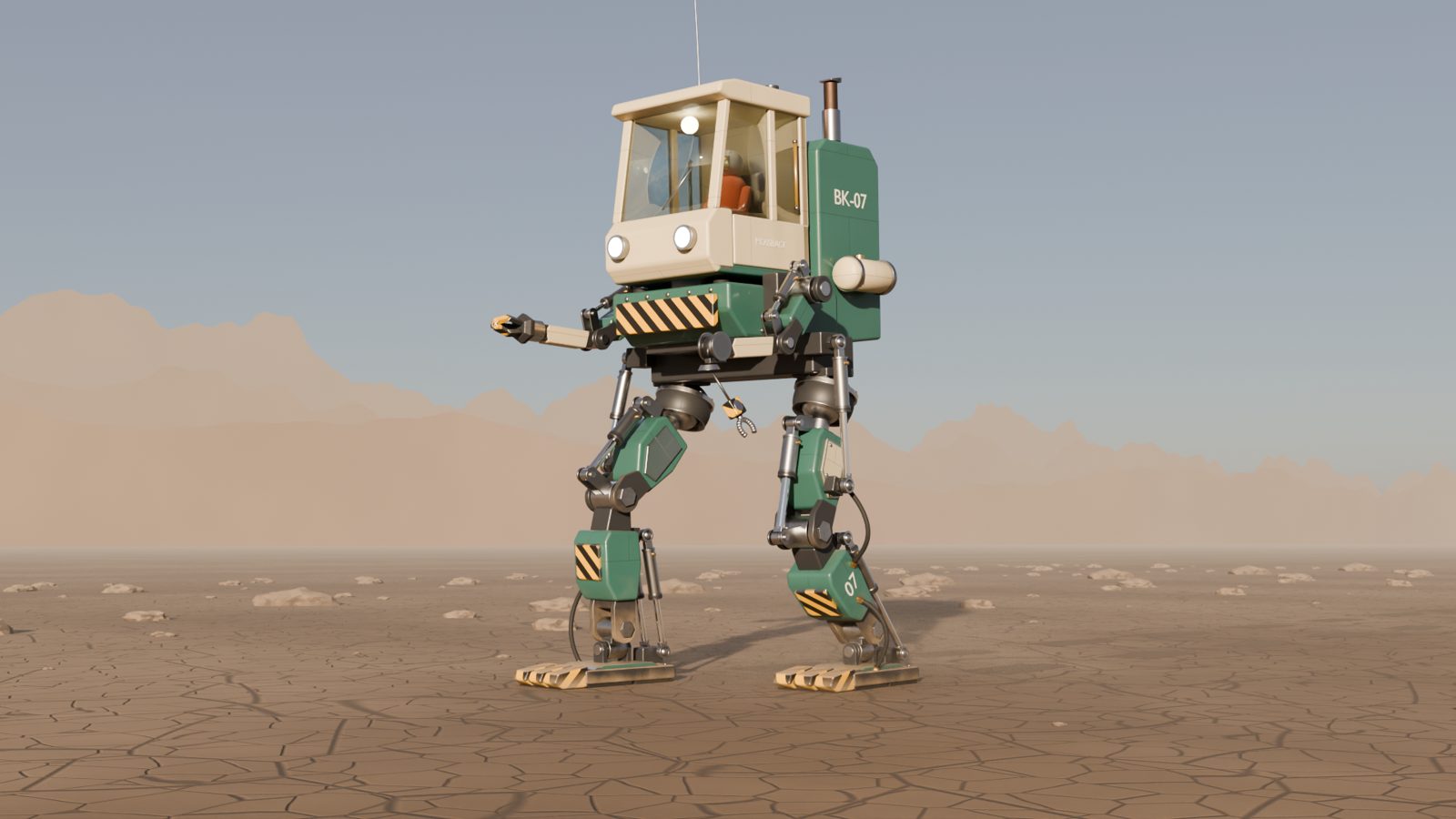
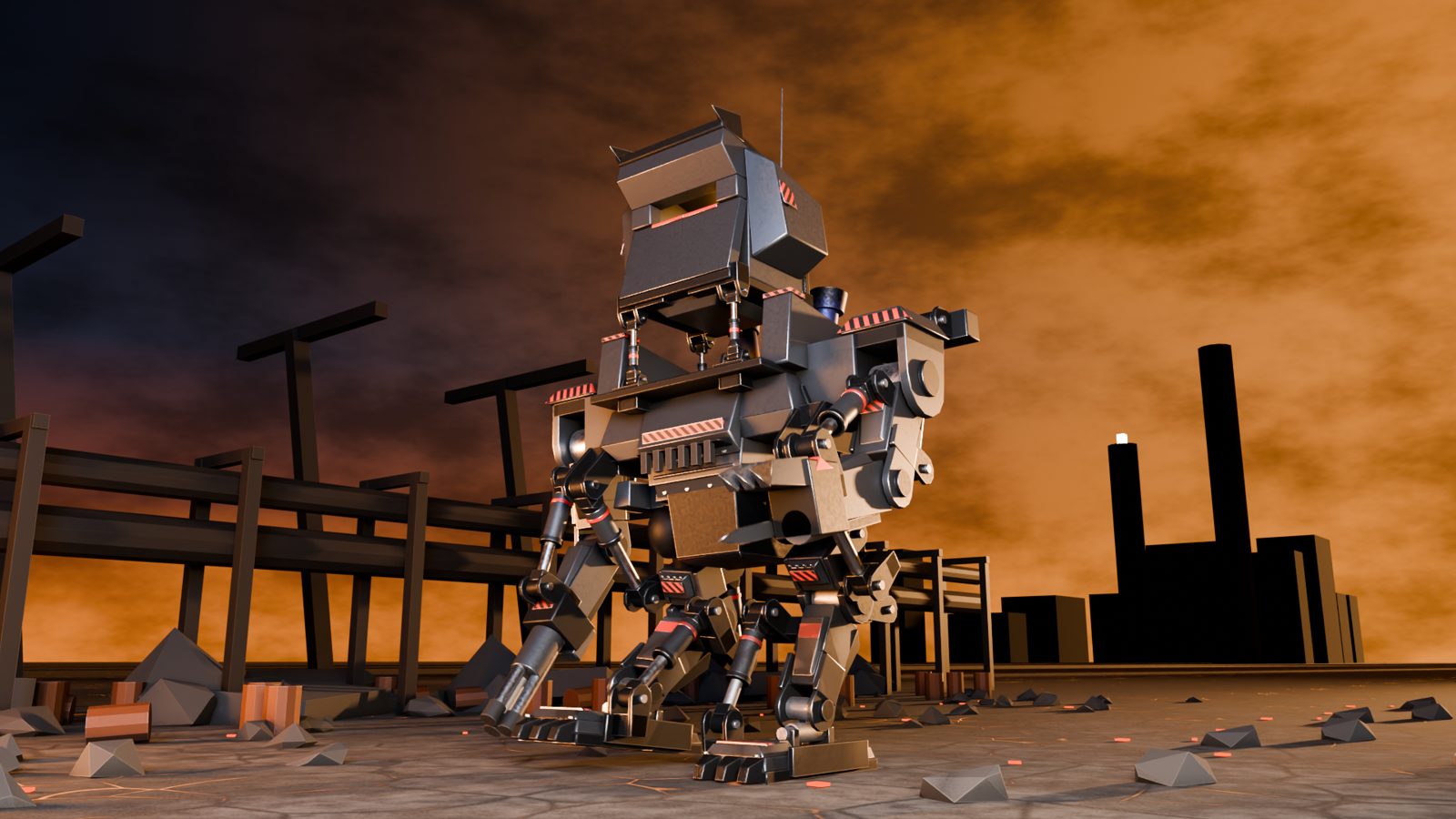
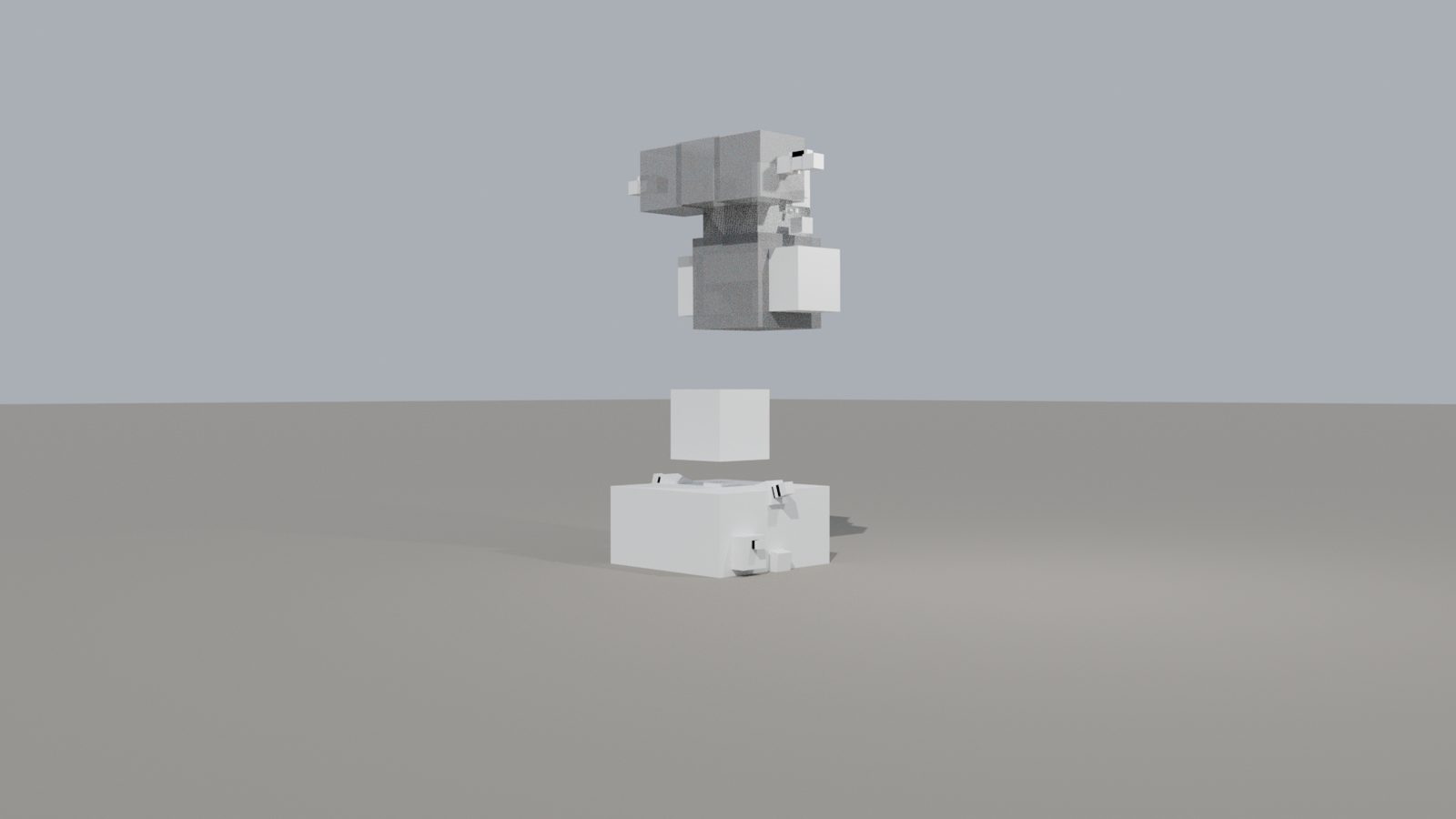
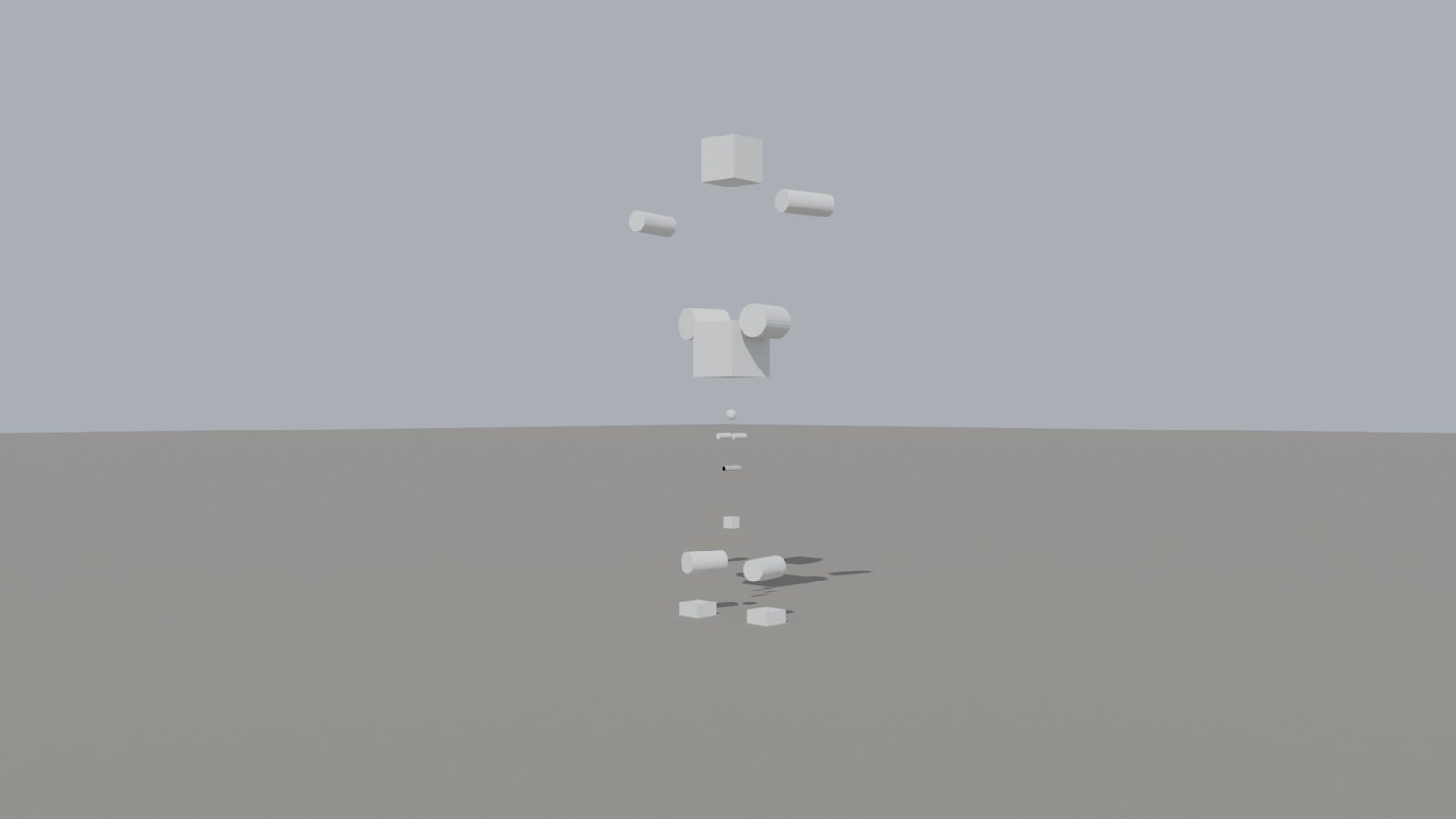
What each one was asked
The method came from the public Higgsfield thread, which showed a 184-part walking mech built in Blender. As we read it, the clip is 82 frames and 19 seconds at 1080p, it was rendered in about 7 minutes on a rented L40S, and every frame was checked for part collisions. These are the figures as we noted them, not ones we could re-check. We borrowed the method and designed our own machines.
The method in one paragraph: build a scale figure first and size everything around it, make every part its own named object, add real joints, make the walk the test by checking every part against every other part on every frame, and fix hits by reshaping parts, never by touching the animation. Render one test frame before the full clip.
Opus and Sonnet
Both got that method and the job of building a walking mech in Blender by script. Sonnet's was pointed at a mean metal look. Each ended with a looping 10 second clip, a pilot in the cab and rams that follow the walk. The packets do not keep the exact prompt text, so there is no quote here.
The local models
These ran through a harness we wrote, with a written brief you can read in scripts/local/brief.md. It asks for one Blender Python script per round. The script has to build a mech 4 to 7 m tall around a pilot. It needs 120 or more named parts and 4 or more rams as barrel and rod pairs, a 48 frame keyed loop with planted feet, and no collisions. The harness runs the script, runs the audit, renders a small still, and sends the model plain text with the numbers. No images go back. Each model got 8 rounds at temperature 0.2.
The method, step by step
Everything below is Blender 5.2 driven from Python, with nothing modeled by hand. Materials are procedural, so there are no baked textures to check.
- Pilot first. A seated adult about 1.78 m tall if standing. The cab is sized around the pilot, the hull around the cab, the legs around the hull. This is what keeps the scale honest.
- One object per part, one body per group of parts. Each part is a named mesh fixed to a rigid body (an empty). Parts never bend. Only the bodies move. Mossback has 376 parts on 35 bodies, Slagjaw 540 on 42.
- Real joints with clearance. Ball-and-socket hips, pinned knees with a bored boss and fork cheeks, a cardan ankle (a pitch pin and a roll pin through a cross block) so the foot stays flat while the body sways. Leave a small clearance in every joint. Mossback used 4% on the bores and sockets, with side gaps of 1.5 cm on the knees.
- Solve the walk, do not key it by eye. Place the feet first (planted in stance, a smooth swing between steps), then use two-bone inverse kinematics to find each leg. The planted foot is pinned, so foot slide is zero by construction.
- Size the rams from the walk. Run the loop, measure each ram's shortest and longest length, then size the barrel and rod so the rod never bottoms out or pulls out of its sleeve.
- The walk is the test. Test every part against every part on every other body, on every frame, with a BVH triangle overlap test plus a ray test for a part sealed inside another. A hit gets fixed by reshaping a part. The walk does not change.
- Test same-body gaps too. The collision test skips parts that share a body, so floating parts get through. Sonnet added a second script that checks each body's parts form one connected cluster. It found 9 floating clusters the walk test could not see.
- Render one frame before the clip. Mossback's first test frame took 141 seconds. Cheaper occlusion and 64 adaptive samples with denoising brought it to about 4 seconds.
To run it yourself, with Blender 5.2 on your path:
blender -b --factory-startup -P mossback_mech.py -- ./blend
blender -b ./blend/06_walk.blend -P mossback_walk_check.py -- ./blend/meta.json ./walk_check.json
blender -b ./blend/06_walk.blend -P same_body_gapcheck.py -- ./blend/meta.json ./gap.json 0.02
A third argument to the walk check sets a frame step if you want a fast pass first. Run the full 240 frames before you believe it. Sonnet's every-eighth-frame runs missed two colliding ram pairs that the full run caught.
The numbers
| Run | Mossback v3 (Opus 5.5) | Slagjaw (Sonnet 5.5) | qwen3-coder 30B | devstral 24B | Scrapjaw (Haiku 5.5, Nov 21) |
|---|---|---|---|---|---|
| Parts | 376 | 540 | 82 | 10 | 127 |
| Rigid bodies | 35 | 42 | not counted | not counted | 16 |
| Rams | 10 | 14 | 0 working | 0 working | 2 |
| Collisions in the walk | 0 on 240 frames | 0 on 240 frames | 1,048 hits, 47 pairs (48 frames) | 96 hits, 2 pairs (48 frames) | 0 on 240 frames |
| Wall time | about 2 h with renders (approximate; the start time was not recorded) | 1 h 32 min (3:14 to 4:45 am), 17 fix loops | 502 s for 8 rounds | 780 s for 8 rounds | 43 min (5:41 to 6:24 am), 4 fix loops, including the render |
| Tokens | not recorded | not recorded | 123,680 in, 35,993 out | 38,864 in, 27,369 out | not recorded |
| Final render | 766 s for 240 frames on a laptop RTX 4090 | 1,109 s for 240 frames on the same card | 1080p still, 540p 48 frame loop | 1080p still, 540p 48 frame loop | 1,953 s for 240 frames on the same card, 96 samples |
| Reviewer score | Called better than the public example, but not clearly | Arguably ahead of Mossback as a machine, worse as a frame | 1 of 10 against Mossback | 1.5 of 10 against Mossback | 5 of 10 for weight at phone size; a stack of boxes to look at |
Each Claude result is one finished build, after revisions (Mossback went through three versions). The Mossback and Slagjaw columns are the November 20 builds; the weight rounds are in the update at the top. The local runs waited behind other GPU jobs for 48 and 90 minutes, and that wait is left out of their times. The cards and sample settings differ, so none of this is a speed race.
What the zeros mean
Foot slide of 0.0 cm tells you the solver pinned the planted feet. It says nothing about whether the walk looks good. The ram rod depth (14.0 cm minimum on Mossback) is the floor the sizing step aims for, worked out from pivot distances, not measured on the meshes. The walk test skips parts on the same body and skips pairs more than 3 cm apart. Mossback's part count includes rows of bolts, so do not compare it to the 184 in the thread, where we do not know how parts were counted.
What went wrong
Opus: wood-grain paint
An early version had a cream paint with one stretched noise in the shader. From a distance it read as wood grain, so the cab looked like a painted toy. Reviewers flagged it, and v3 fixed it by dropping that noise. They also said the hull had no visible weight on each step. v3 put the cab on four rubber isolators that drop up to 3 cm after a footfall. The third reviewer said that at clip size the settle is too small to read, and that Mossback still looks light. A 3 cm drop on a 5.3 m machine does not show on a phone.
Strengthening the arm swing caused new collisions, which the walk test caught: forearm horns hit the upper arms, a winch hook hit the knee, and the cable rubbed its fairlead. All were fixed by reshaping parts.
Sonnet: ram mounts
- A knee ram with its mounts near the knee needs a stroke as long as the whole ram. A grid search over mount points found mounts that fit, and the knee ram ended up at the back of the leg.
- With all three leg rams in one plane they collided on every frame. They went to three different planes.
- A ram barrel wider than its clevis gap swept into its own brackets. The gap grew from 3 cm to 7 cm.
- The dust puffs first rendered as black blobs, because overlapping transparent spheres went past Cycles' transparent bounce limit of 8. Raising the limit to 40 fixed it.
- The first full render was killed at frame 38 when the gap audit showed floating parts and the geometry had to change.
The reviewer's worst note: the cab reads as a boxy head on four thin struts, and the yard is thin. The rocks are low-poly and the factories are extruded boxes.
Local models: the same script again
Both wrote valid Blender Python and followed our naming convention. Then they stalled. qwen3-coder built 82 parts by round 2, and from round 4 it returned the same script every time whatever the feedback said, with two rounds lost to a reply that ended in a half-written tool call. devstral crashed in round 1, ran with 10 parts in round 2, and sent back the same script word for word for the last six rounds. Neither made a working ram or a looping walk.
Part of that is on our harness. At temperature 0.2, identical feedback text produced an identical script. We did not test a higher temperature or plain-text feedback instead of the tool, because each rerun would have waited in the GPU queue. Read the result as true for these two models and this setup only.
What we would do next time
- Put a weight check in the test. Done on November 21, and passing it did not make the mechs look much heavier. The gates need raising.
- Read the camera shake from the stance data, not a fixed 40 frame beat. Done on November 21.
- Fix the shape before the motion. We left the legs alone this time, and thin legs still read as light.
- Frame the camera so the machine fills the phone screen. The last Slagjaw reviewer said it fills less than a third of the frame in its front shot, and every weight cue gets lost at that size.
- Test feet against the rubble and the props, not only the z = 0 plane.
- Run the gap audit from the first build, with the walk test, not as a late addition. Run late, it found 8 floating clusters in Mossback v3.
- Save the exact prompt and the token counts for every run. Our packets have neither for the two Claude runs. We saved Haiku's prompt and still missed its token counts.
- Rerun the local models with a temperature bump on a repeated script, and a plain-text version of the feedback. Use them for boilerplate and test generation before asking them to plan geometry.
- Give the reviewer a named bar from the start. Both of ours used one: the AMP suit from Avatar (2009) for Mossback, and the Titans of Titanfall 2 (Respawn Entertainment, 2016) for Slagjaw. Neither is shown here.
Honest flawReviewer weight scores went up for both mechs, but they stopped around the middle of the scale, well short of the AMP suit and the Titans. Mossback is still a tall body on thin legs. From the front, Slagjaw's cab still reads as a helmet with a flat screen for a face. Our checks cover joint clearances and, since this update, the size of a footfall. None of them measures shape, and the reviewers kept naming shape.
The scripts
These are ours, released under the MIT license (see scripts/LICENSE, copyright BYOK Games, 2026). They contain no keys. Paths are relative, and you need Blender 5.2 for all of them. The render script is not included. The Mossback scripts are now the v6 weight version; the November 20 versions are gone from here, sorry.
- mossback_mech.py
Builds the Mossback mech and its walk (v6). - mossback_scene.py
The set, with dust, clods and camera shake read from the stance data. - weight_check.py
The weight check: drop, settle, overshoot, knee give, sway and foot lift, in phone pixels. - haiku-brief.md
The brief Claude Haiku got. - mossback_walk_check.py
The every-frame collision test, foot slide, ground contact and ram engagement. Its joint check assumes Mossback's 1.2 m legs. - same_body_gapcheck.py
Finds floating parts inside a body. - local/harness.py
The local-model loop. Needs Ollama running and theBLENDERvariable set. - local/audit.py
The collision test generalized to read any scene, plus nine other checks. - local/brief.md
The brief the local models got. - local/render_stage.py
Small test stills and the loop render the harness calls.
Credits and thanks
The thread
Thanks to whoever shared the public Higgsfield mech thread. We took its method and it is why this exists. We have not linked it or named its author, because we did not keep the author's handle with our notes.
Tools
Blender (GPL) and its Cycles renderer (Apache 2.0), from the Blender Foundation. Ollama (MIT). qwen3-coder 30B from the Qwen team at Alibaba and devstral 24B from Mistral AI, both Apache 2.0. Claude Opus 5.5, Claude Sonnet 5.5 and Claude Haiku 5.5 from Anthropic. Scrapjaw was built in Blender 5.3.
Assets
We used no third-party art. Every material and mesh comes from the scripts. Every image and clip on this page is a render of ours. The page uses Archivo Black (SIL Open Font License) and Special Elite (Apache 2.0).